Short answer: dry on low or medium heat and take clothes out while they are still very slightly damp. Almost all the damage people blame on washing happens in the dryer: heat shrinks cotton, destroys elastane, melts synthetic fill and sets creases. The lint in the filter is your clothes. Low heat for longer costs about the same in electricity as high heat for less time, and it is the single biggest thing you can do for how long your clothes last.
What the settings actually do
| Setting | Air temperature | Use it for | What it ruins |
|---|---|---|---|
| High heat | Around 65 to 70 °C | Towels, cotton bedding, nothing else | Elastane, synthetic fill, prints, anything fitted |
| Medium or permanent press | Around 55 °C, with a cool-down | Everyday cotton, shirts, mixed loads | Little, if you take things out damp |
| Low or delicate | Around 40 to 45 °C | Activewear, underwear, anything with stretch, knitwear you dare to tumble | Nothing. Just slow |
| Air fluff or no heat | Room temperature | Freshening, de-linting, removing pet hair, warming up a stiff line-dried item | Nothing. It does not dry, it only moves air |
| Sensor dry | Varies | Full even loads of one fabric type | Mixed loads. It stops when the bulk is dry and over-dries the thin things |
| Timed dry | Varies | Mixed loads and anything you want out damp | Nothing. The most controllable option |
| Steam or wrinkle release | Low with moisture | Shirts that have sat folded, creases from a suitcase | Nothing, and it saves ironing |
How long a load takes
Times are for a standard vented or condenser dryer on medium, with a load spun at 1200 rpm. A heat pump dryer runs cooler and takes roughly half again as long, which is the trade for the gentleness.
| Load | Medium heat | Take out at |
|---|---|---|
| Cotton T-shirts and underwear | 35 to 45 min | Just dry, still cool to the touch |
| Towels | 60 to 80 min | Fully dry. Damp towels sour fast |
| Bedding, one set | 50 to 70 min | Slightly damp, then make the bed with it |
| Jeans and heavy cotton | 50 to 60 min on low | Noticeably damp, then hang |
| Shirts | 20 to 25 min on low | Damp, then hanger, then iron |
| Activewear | 25 to 30 min on low | Just dry. Never on high, ever |
| A duvet or pillows | 2 to 3 hours on low | Bone dry, with dryer balls. See washing duvets and pillows |
Dryer balls, dryer sheets, and which does what
These are not competitors, they do different jobs, and plenty of people use both.
- Wool dryer balls separate the load mechanically so hot air circulates. That cuts drying time by roughly 10 to 25 percent and reduces tangling and creasing. They add no scent and no softness of their own. Six is the useful number for a full load; two does very little.
- Dryer sheets transfer a fine coating onto the fabric, which neutralises static and carries fragrance into the dry load. That coating is the point and also the limitation: see what dryer sheets do and how they compare to fabric softener. Our dryer sheets are the step that puts the fragrance on dry fabric, where it lasts rather than rinsing away.
- Neither on towels and activewear. Dryer sheets reduce towel absorbency and clog the pores of performance fabric. Dryer balls are fine on both and actually help towels fluff.
- Tennis balls are not a substitute. They are not designed for 65 °C and the rubber smell transfers.
Air drying without stiff clothes
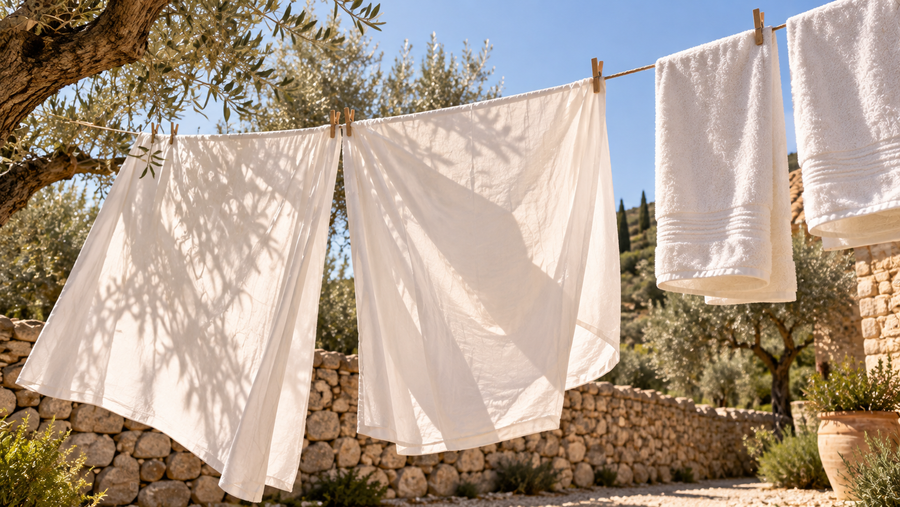
Line-dried clothes go board-stiff for two reasons: hard water minerals drying in the fibre, and cotton with nothing agitating it as the water leaves. Both are fixable.
- Spin properly first. 1000 to 1200 rpm. Every extra minute of spin is drying time you do not pay for.
- Shake each item hard before hanging. This is most of the softness, and it takes two seconds.
- Hang with airflow, not just space. A cracked window or a fan does more than a warm still room. Still air at 22 °C dries slower than moving air at 15 °C.
- Hang shirts and dresses on hangers, knitwear flat, trousers from the waistband, towels spread along the full rail rather than folded over it.
- Keep colours out of direct sun, but put whites in it. Sunlight bleaches, which is a problem or a gift depending on the garment.
- Finish in the dryer for five minutes on low if things dry stiff. The tumbling, not the heat, is what softens them.
- Indoors, use a dehumidifier rather than a radiator. Drying a full load indoors puts around two litres of water into the room, which is how damp and mould start.
Never put these in a dryer
- Wool and cashmere, which felt irreversibly. Dry flat.
- Silk, which goes brittle and loses lustre.
- Anything with elastane you care about the fit of: swimwear, sports bras, shapewear, stretch jeans.
- Waterproof shells with a membrane, unless the care label explicitly asks for heat to reactivate the finish — some do, which is covered in how to wash a winter coat.
- Bras with moulded cups, which deform permanently. See washing bras and lingerie.
- Anything with a plastic or vinyl print, which cracks and peels.
- Anything with a grease stain still in it. Heat sets oil permanently.
- Trainers, unless the dryer has a rack. Tumbling them destroys the glue and the drum. See washing shoes.
Keeping the dryer working
- Clear the lint filter every single load. A half-blocked filter adds 20 minutes and is the most common cause of dryer fires.
- Wash the filter in warm soapy water every month or two. Dryer sheet residue forms an invisible film on the mesh that stops air passing; if water sits on the filter instead of running through, that is the film.
- Check the outside vent twice a year for lint and nests, and keep the hose as short and straight as it will go.
- On a condenser or heat pump dryer, rinse the lower filter block monthly and empty the tank every load.
- Do not overload. A dryer needs roughly a third of the drum empty to move air; a packed drum dries unevenly and creases everything.
- Dry a full load rather than three small ones. Heat per garment is what wears clothes, and a small load gets far more of it.
Common problems
| Problem | Cause | Fix |
|---|---|---|
| Everything takes two cycles | Blocked filter or vent, or a weak spin | Wash the filter, check the vent, raise the spin speed |
| Clothes come out hot and creased | Left sitting in the drum after the cycle | Out within minutes, or use a cycle with a cool-down |
| T-shirts shrinking every wash | High heat, not the wash | Medium or low, and out while damp |
| Towels no longer absorbent | Dryer sheets or fabric softener coating | Two hot washes with 120 ml white vinegar and no detergent, then dryer balls only |
| Static in every load | Over-dried synthetics in dry air | Take the load out damp. Full list in how to get rid of static cling |
| Load smells musty despite drying | It sat wet in the washer before drying | Rewash. Cause explained in why clothes smell after washing |
| Puffer jacket came out lumpy | High heat melted synthetic fill | Not reversible. Low heat and dryer balls next time |
| Dark clothes covered in lint | Dried with towels | Separate loads. See lint and pet hair |
| Brown or grey marks on clothes | A melted plastic item, or scorching from a failing thermostat | Check the drum for residue. If it recurs, stop using it and have it serviced |
Frequently asked questions
How long should clothes take to dry in a dryer?
A normal cotton load takes 35 to 45 minutes on medium, towels 60 to 80, and jeans about an hour on low. A heat pump dryer runs cooler and takes around half again as long. If a standard load is taking two cycles, the lint filter or the vent is blocked.
Should you dry clothes on high or low heat?
Low or medium for nearly everything. High heat is only appropriate for towels and cotton bedding; it is what shrinks cotton, destroys elastane and melts synthetic insulation. Running low for longer uses a similar amount of electricity and does far less damage.
Do dryer balls actually work?
Yes, mechanically. Wool dryer balls separate the load so hot air circulates, which cuts drying time by roughly 10 to 25 percent and reduces creasing and tangling. They do not add scent or softness, and you need about six for a full load.
Are dryer balls better than dryer sheets?
They do different jobs. Dryer balls speed up drying and reduce creasing. Dryer sheets neutralise static and put fragrance onto dry fabric, which is where scent lasts longest. Many people use both, though neither dryer sheets nor softener belong on towels or activewear.
Why are my clothes stiff after air drying?
Hard water minerals drying in the fibre, and no tumbling to break the fibres apart. Shake each item hard before you hang it, spin at a higher speed first, and finish with five minutes in the dryer on low, which softens by movement rather than heat.
Is it better to air dry or tumble dry?
Air drying is gentler and free, and it is the right choice for wool, silk, elastane and anything fitted. A dryer is better for towels, for bedding and for softness, and it is faster. The sensible system is both: tumble the robust things, hang the delicate and the stretchy.
Should you take clothes out of the dryer damp?
Yes, for everything except towels. The last ten minutes of a cycle, when fabric is already dry, is where most heat damage happens. Taking things out very slightly damp and hanging them also removes most of the creasing.
How often should you clean a dryer lint filter?
Every load, and wash it in warm soapy water every month or two. Dryer sheet residue builds an invisible film on the mesh that blocks airflow even when the filter looks clean. If water pools on the filter instead of passing through, the film is there.