Short answer: you cannot add a good smell on top of a bad one. Find the source first — damp, body oil in unwashed clothes, old wood, or a carpet under the wardrobe — fix it, then build the scent in three layers: clean clothes that already carry fragrance, something in the air of the wardrobe itself, and something that absorbs moisture so the smell does not turn. A wardrobe is a sealed box with almost no airflow, which is why a single damp towel can set the smell of a whole season.
First, what is the smell?
| Smell | Almost always | Fix the cause |
|---|---|---|
| Musty, like a cellar | Humidity above about 60 percent and mould on the back wall or the clothes | Dehumidify, wipe the carcass, wash the clothes. Scent will not cover it |
| Sour or stale | Body oil in clothes that were put away worn, or still slightly damp | Rewash. Nothing worn more than once goes back in |
| Sharp and chemical | Naphthalene mothballs, present or historic | Remove them, air for a week, replace with cedar. The smell outlasts the balls by months |
| Sweet and dusty | Old potpourri or a sachet that has gone off | Throw it out. Dried botanicals turn within a year |
| Like the wood itself | Old chipboard, varnish, or plywood off-gassing in a warm room | Line the shelves with paper, and keep the doors open an hour a day for a fortnight |
| Like cigarettes or cooking | Smoke absorbed into wool and cotton, which hold it well | Wash or air every garment. The wardrobe is innocent here |
| Faintly like a cat | Ammonia, usually from something behind or under the unit | Move the wardrobe and look. This one is never the clothes |
Reset the wardrobe first
- Empty it completely. Everything out, including what is on the floor of it, which is usually where the problem lives.
- Wipe the inside with a cloth wrung out in warm water and a little white vinegar. Get the back corners and the underside of the shelves.
- Leave it open and empty for a day, ideally with a fan pointed into it. It must be bone dry before anything goes back.
- Sort what comes back. Anything worn and not washed goes in the laundry basket, not back on the rail. This is the step that actually decides the smell.
- Check your humidity. A cheap hygrometer costs very little. Above 60 percent, no amount of fragrance will hold, and mould is a matter of time.
- Leave 10 percent of the rail empty and keep clothes off the back wall. Air has to be able to move or nothing dries.
The three layers
Layer one: the clothes
Fragrance that lasts in a wardrobe comes out of the wash, not out of a sachet. A sachet perfumes the air around a garment; the wash perfumes the fibre, which is what you smell when you put it on six weeks later. The mechanics of that are in how to make laundry smell good for weeks, and the short version is: correct dose, cold wash, and dryer sheets on the dry load rather than softener in the rinse, because anything added to the rinse water largely goes down the drain with it. Store clothes bone dry. Fabric that is even slightly damp turns sour in a closed space within days, and that smell then transfers to everything touching it.
Layer two: the air
| Option | Lasts | Good for | Watch out for |
|---|---|---|---|
| Cedar blocks or rings | Years, with sanding | Wool storage, a dry clean smell, mild moth deterrence | The scent fades in months; sand lightly to bring it back. Do not oil it |
| Lavender sachets | 6 to 12 months | Drawers, linen, moth deterrence | Goes dusty and sweet when old. Replace, do not top up |
| A used dryer sheet | 4 to 8 weeks | Drawers, shoe boxes, suitcases, matching the laundry scent exactly | Nothing. The cheapest thing on this list and the most consistent |
| Scented drawer liners | 6 to 12 months | Drawers, shelves, covering an old-wood smell | Can mark pale silk. Use paper over them |
| A soap bar in its wrapper | A year or more | Linen cupboards, drawers | Keep it wrapped and off the fabric |
| Reed diffuser | 2 to 3 months | Walk-in wardrobes with some air movement | Oil creep onto the surface below. Not for a closed cupboard |
| Coffee beans or bicarbonate | 1 to 2 months | Removing a bad smell, not adding a good one | They absorb, which also means they absorb your laundry scent |
Layer three: the moisture
- Silica gel sachets, the kind that come in packaging, work genuinely well. Collect them, or buy a bag of the reusable indicating type and dry them in a low oven when they change colour.
- A small tub of calcium chloride crystals in a wardrobe that sits against an outside wall. Empty the water weekly.
- A dehumidifier in the room, not in the wardrobe, if you line dry indoors. See how to dry clothes properly.
- Never store anything in a plastic dry-cleaning bag. It traps solvent and moisture against the fabric, and it is the most common cause of a yellowed shoulder.
- Cotton garment bags for anything you are storing long term. They keep dust off and let the fabric breathe.
Drawers, shoes and suitcases
- Drawers hold scent far better than wardrobes because the volume is small. One used dryer sheet at the bottom under the liner paper is enough for a whole drawer.
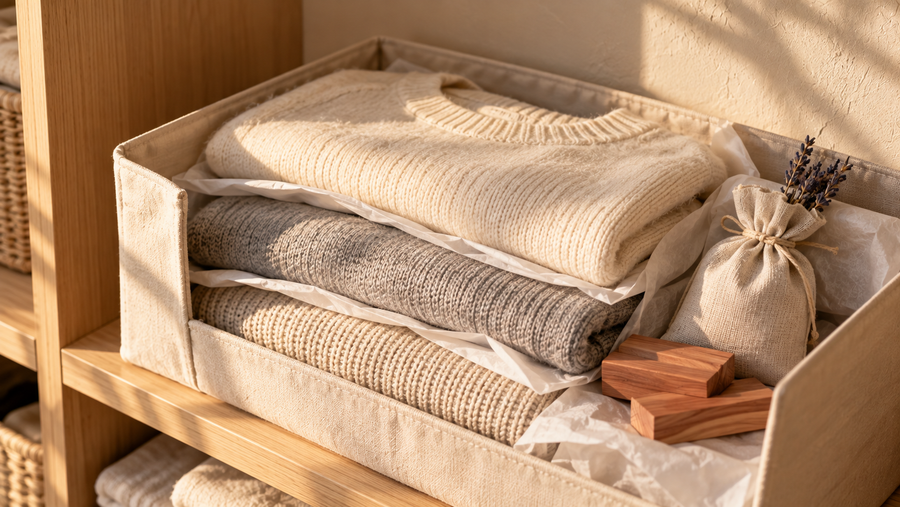
- Fold knitwear rather than hanging it, and keep it in the drawer with cedar. Hanging stretches the shoulders and exposes wool to more air and more moths.
- Shoes need deodorising, not perfuming. Bicarbonate overnight, tipped out in the morning, then cedar shoe trees. A scented sachet on top of shoe odour smells worse than either.
- Suitcases get stored open with a dryer sheet inside. Closed and empty, they develop their own smell within a month, and it goes straight into your clothes on the next trip — relevant to laundry away from home.
- Linen cupboards benefit from rotation more than fragrance: front to back, so nothing sits for a year. The full routine is in the Linen Book.
Moths, without the mothball smell
Clothes moths eat keratin, so they want wool, cashmere, silk and felt, and they are drawn to it by body oil and sweat rather than by the fibre itself. A clean jumper is a far less attractive target than a worn one.
- Wash or dry clean wool before storing it for a season. This matters more than anything you put in the wardrobe.
- Cedar and lavender are deterrents, not insecticides. They discourage moths from settling; they do not kill larvae already in the fabric.
- Naphthalene mothballs do work and smell appalling for years afterwards. The trade is rarely worth it.
- Pheromone traps tell you whether you have a problem and how bad. Cheap and worth it once a year.
- If you find damage, 48 hours in a freezer in a sealed bag kills every life stage. Repair guidance is in the Rescue Book.
- Vacuum the wardrobe floor and the corners. Larvae live in dust and lint as happily as in a jumper.
Common problems
| Problem | Cause | Fix |
|---|---|---|
| The scent is gone in a week | Fragrance was only in the air, not in the fibre | Build it in the wash. Sachets are a top-up, not the source |
| Clothes smell fine on the rail, stale once worn | Body oil left in them from the last wear | Washing problem, not a storage one. See why clothes still smell |
| Musty smell comes back every winter | Condensation on an outside wall behind the wardrobe | Pull the unit 5 cm off the wall and add a moisture absorber |
| Everything smells of one strong item | A leather jacket, a scented candle or a new rubber-soled shoe | Take it out. Enclosed spaces average towards the loudest smell |
| White or grey bloom on wool | Mould from humidity | Brush outdoors when dry, then wash or dry clean. Fix the humidity or it returns |
| Yellow marks on stored shoulders | Plastic dry-cleaning bags | Remove every bag. Oxygen bleach soak for whites; often permanent on silk |
| Drawer liners marked a silk blouse | Fragrance oil transfer | Plain tissue between the liner and the fabric |
| Mothball smell years after removal | Naphthalene absorbed into the wood | Wipe with vinegar, leave open a fortnight, then seal with shellac if it persists |
Frequently asked questions
How do you make a closet smell good?
Fix the cause of any bad smell first, because fragrance does not cover damp or body oil. Then work in three layers: clothes that carry scent out of the wash, something scented in the wardrobe air such as cedar or a used dryer sheet, and a moisture absorber so the smell does not turn.
Why does my wardrobe smell musty?
Humidity above roughly 60 percent, almost always, with mould growing on the back wall or on the clothes themselves. Clothes put away slightly damp will do it on their own. Empty it, wipe it with diluted white vinegar, dry it completely and add a moisture absorber.
What is the best thing to put in a closet to smell good?
Cedar blocks for wool storage and a dry, clean scent; lavender sachets for drawers and linen; and a used dryer sheet if you want the wardrobe to match your laundry exactly, which is both the cheapest option and the most consistent. Avoid reed diffusers in closed cupboards, where the oil creeps.
How long do closet sachets last?
Lavender and botanical sachets last six to twelve months and should be replaced rather than topped up, since dried botanicals go dusty and sweet. Cedar lasts years if you sand the surface lightly when the scent fades. A used dryer sheet lasts four to eight weeks.
Do cedar and lavender actually stop moths?
They deter moths from settling but do not kill larvae already in a garment. The thing that genuinely protects wool is storing it clean, because moths are attracted by sweat and body oil rather than by the fibre. If you find damage, 48 hours in a sealed bag in the freezer kills every life stage.
How do you get the mothball smell out of a wardrobe?
Remove the mothballs, empty the unit, wipe it down with diluted white vinegar and leave it open with airflow for a fortnight. Naphthalene absorbs into bare wood, so if the smell persists, sealing the inside with shellac is the reliable answer. Replace the mothballs with cedar.
Should you use fabric softener to make clothes smell good in storage?
No. Softener is added to the rinse, so most of the fragrance leaves with the rinse water, and the coating it leaves reduces the absorbency of towels and linen. Putting scent onto the dry load instead puts it where it lasts.
Can you store clothes in dry-cleaning bags?
No. The plastic traps residual solvent and moisture against the fabric and is the usual cause of yellowed shoulders on stored garments. Take the bags off the day they come home and use breathable cotton garment bags for anything stored long term.