Short answer: front-load machines use the least water, clean best, spin fastest and are gentlest on fabric, but take longer and need the door left open to avoid smelling. Top-load impellers (HE) are a close second. Top-load agitators are fastest and cheapest but use three to four times the water and are hardest on clothes. All HE machines — front-load and top-load impeller — need low-sudsing HE detergent at roughly a quarter of the dose an old agitator used, and more than that is the single most common cause of residue, smells and poor cleaning.
The three machines
| Top-load agitator | Top-load impeller (HE) | Front-load (HE) | |
|---|---|---|---|
| How it cleans | Central post twists clothes through water | Low disc rubs clothes against each other | Drum tumbles clothes through a shallow pool |
| Water per load | Around 150 litres / 40 gallons | Around 50 litres / 13 gallons | Around 45 litres / 12 gallons |
| Cleaning performance | Adequate | Good | Best |
| Gentleness | Hardest on fabric | Moderate | Gentlest |
| Spin speed | 600 to 800 rpm | 800 to 1,000 rpm | 1,200 to 1,600 rpm |
| Cycle time | 30 to 45 minutes | 50 to 70 minutes | 60 to 120 minutes |
| Capacity for bulky items | Poor, the post takes space | Good | Best, no obstruction |
| Detergent needed | Normal, any format | HE, low-sudsing | HE, low-sudsing |
| Smell risk | Low, it air-dries open | Low to moderate | Highest, the door seal traps water |
| Add clothes mid-cycle | Yes | Yes | Only with an add-item door |
| Typical lifespan | 10 to 14 years, simple mechanics | 10 to 13 years | 10 to 13 years, more to go wrong |
What HE actually means
High-efficiency describes a machine that washes in a shallow pool rather than a full tub. Clothes are lifted and dropped, or rubbed against each other, instead of swirling in a large volume of water. Less water means less energy to heat it, and a faster spin means less work for the dryer.
It also means the detergent is working in a far more concentrated solution, and there is not enough water to rinse away excess suds. HE detergent is formulated to produce very few suds for that reason. Putting normal detergent, or too much HE detergent, into an HE machine creates a foam cushion that stops clothes rubbing against each other — so the load comes out less clean, not more — and leaves residue behind in the fabric and the machine.
How much to use
| Machine | Liquid dose | Pods | Where it goes |
|---|---|---|---|
| Top-load agitator | Full dose on the cap, around 60 ml | 1 per normal load | Into the water as the tub fills |
| Top-load impeller (HE) | Around 25 to 35 ml | 1 per normal load | Pod in the empty drum first |
| Front-load (HE) | Around 25 to 35 ml | 1 per normal load | Pod in the empty drum first, liquid in the drawer |
| Any machine, hard water | Up to 1.5x, or switch to powder | 2 for a large or heavily soiled load | See hard water guide |
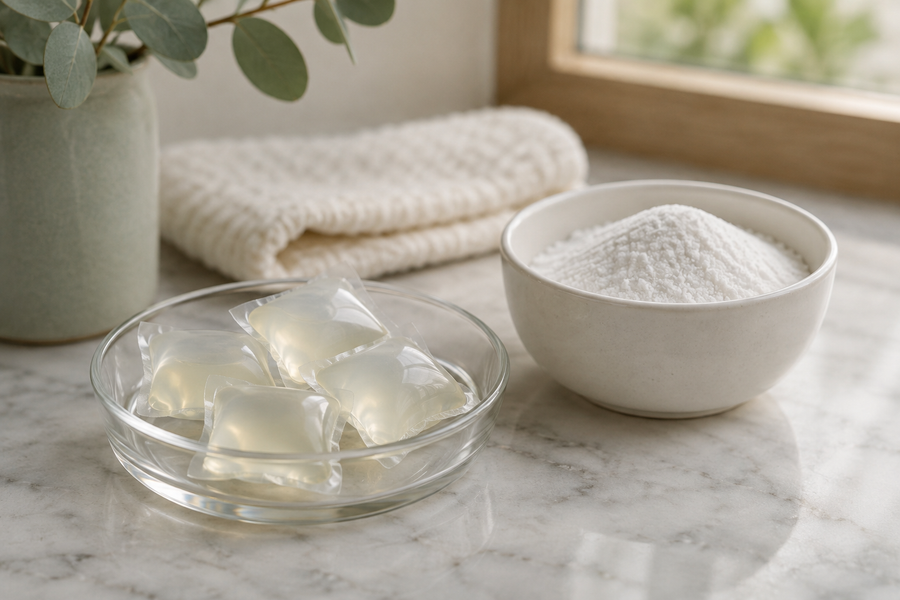
Pods sidestep the question entirely, which is most of their appeal: the dose is fixed in the film and works across all three machine types. They do need to go into the empty drum before the clothes so water reaches the film immediately, as explained in how to use laundry pods.
How to get the best from a front-loader
- Leave the door ajar between washes and wipe the rubber seal dry. Every front-loader smell problem begins with a closed door and a wet seal.
- Pull back the seal and check the fold weekly. Hair, lint and water collect in there and that is where the smell lives.
- Load to two-thirds full, loosely. Clothes need room to tumble and drop; a packed drum just rotates as a block and nothing gets clean.
- Run a monthly maintenance wash empty and hot. The full routine is in cleaning a washing machine.
- Clean the drain pump filter twice a year, behind the panel at the bottom front. Most people never open it, and it is the usual reason a machine stops draining well.
- Use the high spin on towels and jeans, the low spin on knitwear and anything with elastane. High spin is why a front-loader cuts dryer time.
How to get the best from a top-loader
- On an agitator, load evenly around the post and never wrap a sheet or duvet cover around it. That is what tears seams and throws the drum off balance.
- On an impeller, lay items flat in a layer rather than dropping them in as a ball, and distribute weight evenly. An unbalanced impeller load will not spin properly.
- Let the tub fill before adding detergent on an agitator, so it dissolves rather than landing directly on fabric.
- Use a mesh bag for anything delicate. Agitators are rough; bras, tights and lingerie need the protection described in washing bras and lingerie.
- Use the deep-fill or extra-water option on an impeller for bedding and bulky loads. The default sensor fill is often too mean for a duvet cover.
- Leave the lid open after the last load so the tub dries out.
Why machine type affects scent: fragrance has to be deposited onto fibre during the wash and then survive the rinse. In an underfilled HE machine with too much detergent, the foam prevents proper contact and the extra rinse water carries fragrance away, which is why people report a scent fading by the time clothes are dry. A fixed-dose pod in a two-thirds-full drum solves both at once, and a matching dryer sheet adds the top note back after a high spin. The full mechanism is in making laundry smell good for weeks.
Which to buy
| If you | Choose | Why |
|---|---|---|
| Wash a lot of bedding and bulky items | Front-load | No agitator post, largest usable drum |
| Care most about fabric lifespan | Front-load | Tumbling is far gentler than twisting |
| Want the lowest water and energy bills | Front-load | Least water, fastest spin, least dryer time |
| Cannot bend down easily | Top-load impeller | Loading height, no pedestal needed |
| Want short cycles above all | Top-load agitator | 30 to 45 minutes against 60 to 120 |
| Have had front-loader smell problems | Top-load impeller | No door seal to trap water |
| Wash very dirty workwear | Top-load agitator or front-load with a soak | Mechanical action, or time. See washing workwear |
| Are stacking with a dryer | Front-load | The only type that stacks |
Common problems
| Problem | Cause | Fix |
|---|---|---|
| Front-loader smells musty | Door kept shut, water in the seal | Door ajar, dry the seal, monthly hot empty wash |
| White marks on clothes in an HE machine | Too much detergent, or non-HE detergent | Quarter the dose. See white residue on clothes |
| Clothes still dirty in a new HE machine | Overloaded, so nothing can tumble | Two-thirds full, loosely packed |
| Machine will not spin, keeps rebalancing | Single heavy item, or uneven impeller load | Redistribute. Add a towel to balance one heavy item |
| Agitator tore a seam | Item wrapped around the post | Load around the post, mesh bags for delicates |
| Cycle takes two hours | Normal for a front-loader sensing soil and rinsing | Use a quick cycle for lightly worn loads |
| Clothes come out very creased | High spin on a packed drum | Lower spin, smaller load. See creases without an iron |
| Water not draining fully | Blocked drain pump filter | Clean the filter behind the lower front panel |
Frequently asked questions
Is a front-load or top-load washer better?
Front-load machines clean better, use roughly a third of the water, spin much faster so clothes leave the drum drier, and are considerably gentler on fabric. Top-loaders are cheaper, have shorter cycles, let you add items mid-wash and do not develop door-seal smells. For fabric lifespan and running cost, front-load wins; for convenience and simplicity, top-load does.
What does HE mean on a washing machine?
High-efficiency: the machine washes in a shallow pool of water rather than a full tub, using tumbling or rubbing instead of a central agitator. That cuts water and energy use substantially, but it also means detergent works in a much more concentrated solution, so HE machines need low-sudsing HE detergent at a far smaller dose.
How much detergent should you use in an HE washer?
Roughly a quarter of what an old agitator machine used — about 25 to 35 ml of liquid for a normal load, or one pod. Excess detergent creates suds that cushion the clothes and stop them rubbing together, so the load comes out less clean, and the small amount of rinse water cannot carry the residue away.
Can you use regular detergent in an HE washer?
You should not. Regular detergent is formulated to produce suds in a large volume of water, and in an HE machine it foams far too much. That reduces cleaning performance, leaves residue in fabric and in the machine, and over time contributes to smells. If you have no HE detergent, use a very small amount of regular as a one-off.
Why does my front-load washer smell?
Water sits in the fold of the rubber door seal, and with the door closed between washes it never dries. Pull the seal back and wipe it dry after the last load, leave the door ajar, and run a monthly hot empty cycle. Excess detergent and fabric softener make it worse by leaving a film for bacteria to live on.
Are agitator washers harder on clothes?
Yes. An agitator cleans by twisting clothes against a central post, which is mechanically aggressive: it is the reason for stretched necklines, torn seams and faster fading in older machines. Impeller and front-load machines rub or tumble clothes instead, which is gentler but slower.
Do pods work in both machine types?
Yes. The dose is fixed in the film and is formulated to be low-sudsing, so one pod suits an agitator, an impeller and a front-loader alike. Put it in the empty drum before the clothes rather than in the dispenser drawer, so water reaches the film immediately and it dissolves fully.
How full should you load a washing machine?
About two-thirds, loosely, with room to put a flat hand on top of the load. Clothes need space to move against each other, because that movement is what does the cleaning. A packed drum rotates as a single block, washes badly, rinses worse and creases everything.